
Computing in Hilbert Space: The Hidden Layer Driving Quantum Advantage
Why the next wave of innovation will be defined by abstract state spaces, not physical hardware

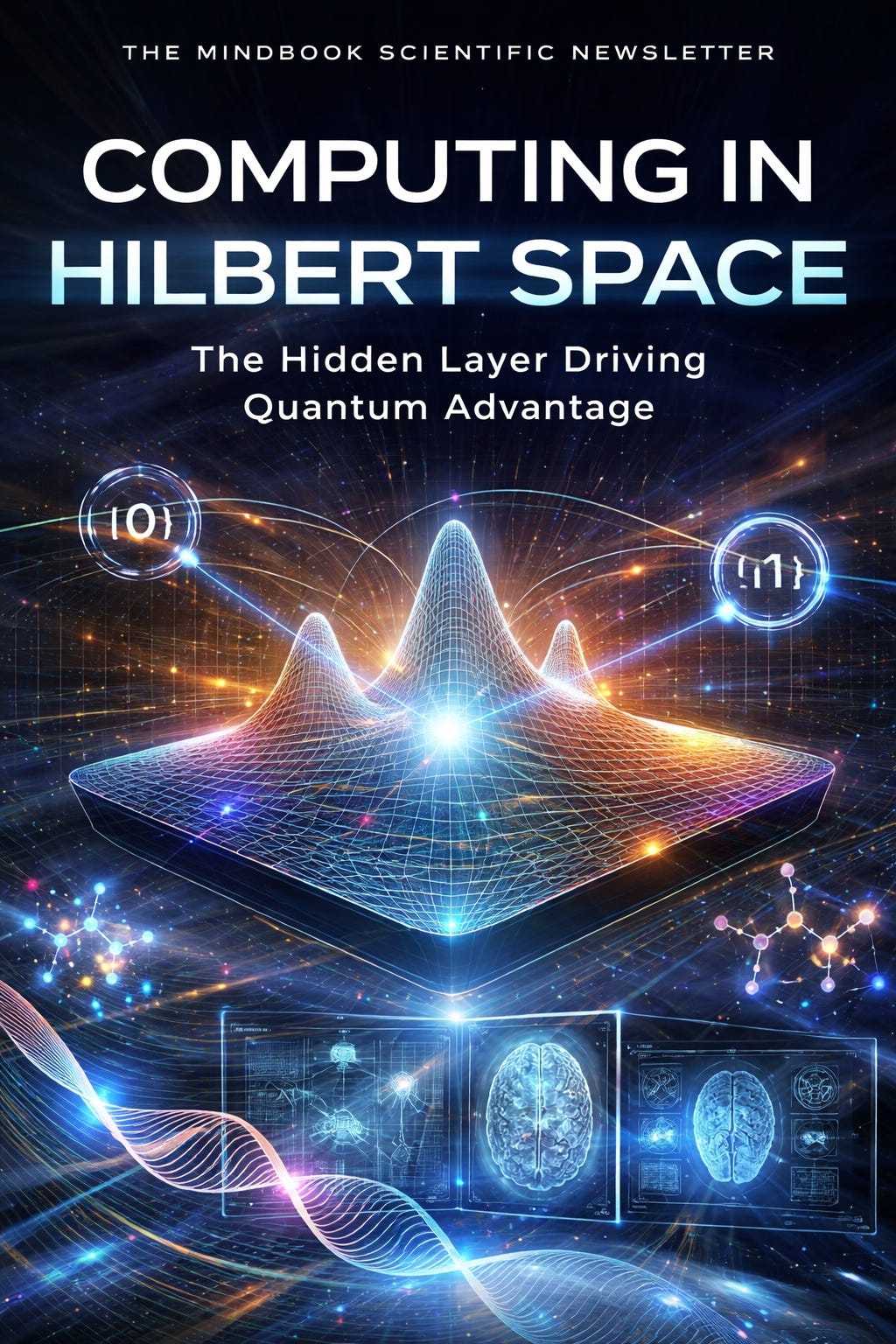
Abstract
Much of the public discussion around quantum computing focuses on hardware, qubit counts, and error rates. Yet the true source of its potential lies elsewhere, in the structure of Hilbert space, where quantum states evolve and computation takes place. This issue examines how operating in high-dimensional state spaces changes the nature of problem-solving, and why this perspective opens new directions for healthcare, materials science, and machine learning.
1. Beyond Hardware: Where Quantum Computation Really Happens
Quantum processors are built from physical systems such as superconducting circuits or trapped ions. However, the computation itself does not occur in physical space in the classical sense. It unfolds in a mathematical structure known as Hilbert space.
Each quantum state is represented as a vector, and operations correspond to transformations of that vector. For a system of (n) qubits, the state space grows exponentially as (2^n). This exponential structure is not a feature of hardware scaling alone, but of representation.
The implication is direct. Quantum advantage arises not simply from speed, but from the ability to encode and manipulate information in spaces that are inaccessible to classical representations [1], [2].
2. The Geometry of Information
In classical systems, data is stored as discrete values. In quantum systems, information is encoded in amplitudes and phases.
This introduces a geometric perspective:
Computation becomes rotation in complex vector spaces
Correlations are embedded as entanglement
Interference patterns guide outcomes toward optimal solutions
This geometric structure allows quantum algorithms to explore solution spaces in ways that differ fundamentally from classical search methods [3], [4].
3. Implications for Machine Learning
Most machine learning models struggle with high-dimensional, sparse, or noisy data. Quantum computing offers a different approach by embedding data directly into Hilbert space.
Emerging methods such as quantum kernel estimation and variational circuits allow:
Efficient representation of complex feature spaces
Enhanced pattern recognition in limited datasets
New forms of model expressivity
This is particularly relevant for healthcare data, where sample sizes are often small but feature complexity is high [5], [6].
4. Healthcare as a Testbed
Healthcare systems present ideal conditions for Hilbert-space-driven computation:
Molecular interactions are inherently quantum
Imaging data is high-dimensional and noisy
Patient outcomes depend on subtle, nonlinear correlations
Quantum approaches are being explored for:
Drug discovery through accurate molecular simulation
Imaging reconstruction using quantum-inspired techniques
Precision medicine via quantum machine learning
These applications do not require full-scale fault-tolerant quantum computers. Hybrid models already demonstrate early promise [7], [8].
5. The Underexplored Opportunity
The dominant narrative in quantum technology emphasizes hardware competition. However, a quieter and potentially more impactful frontier lies in:
Designing algorithms that exploit Hilbert space geometry
Developing domain-specific quantum representations
Bridging classical data with quantum state encoding
For emerging research communities, this is a strategic entry point. It shifts focus from infrastructure limitations to intellectual contribution.
6. Rethinking Scientific Training
If computation is moving into abstract state spaces, then training must adapt.
Future scientists will need:
Linear algebra and functional analysis as core tools
Familiarity with quantum state representations
Ability to translate real-world systems into mathematical structures
This shift is not limited to physicists. It applies to engineers, clinicians, and data scientists working at the edge of complexity.
7. A Realistic Outlook
Quantum computing remains constrained by noise, decoherence, and limited qubit counts. Yet these constraints do not diminish the importance of its conceptual framework.
Understanding Hilbert space is not a future requirement. It is a present advantage.
Those who engage with it now will define how quantum systems are applied across disciplines.
Conclusion
The future of computation will not be defined solely by faster machines, but by richer representations of information. Hilbert space provides such a framework.
Quantum computing matters because it changes where and how problems are solved. It moves computation from physical configurations to abstract structures, where complexity can be managed in fundamentally new ways.
References
[1] M. A. Nielsen and I. L. Chuang, Quantum Computation and Quantum Information, Cambridge University Press, 2010.
[2] J. Preskill, “Quantum Computing in the NISQ era and beyond,” Quantum, vol. 2, p. 79, 2018.
[3] R. P. Feynman, “Simulating physics with computers,” International Journal of Theoretical Physics, vol. 21, pp. 467–488, 1982.
[4] P. W. Shor, “Algorithms for quantum computation: Discrete logarithms and factoring,” Proc. 35th Annual Symposium on Foundations of Computer Science, 1994.
[5] V. Dunjko and H. J. Briegel, “Machine learning and artificial intelligence in the quantum domain,” Reports on Progress in Physics, vol. 81, no. 7, 2018.
[6] M. Schuld and F. Petruccione, Supervised Learning with Quantum Computers, Springer, 2018.
[7] S. Cao et al., “Quantum chemistry in the age of quantum computing,” Chemical Reviews, vol. 119, no. 19, pp. 10856–10915, 2019.
[8] K. Biamonte et al., “Quantum machine learning,” Nature, vol. 549, pp. 195–202, 2017.
[9] A. Peruzzo et al., “A variational eigenvalue solver on a quantum processor,” Nature Communications, vol. 5, 2014.
[10] E. Farhi and H. Neven, “Classification with quantum neural networks on near term processors,” arXiv:1802.06002, 2018.
Blessed Yahweh
EduTech | The MindBook Scientific Series