
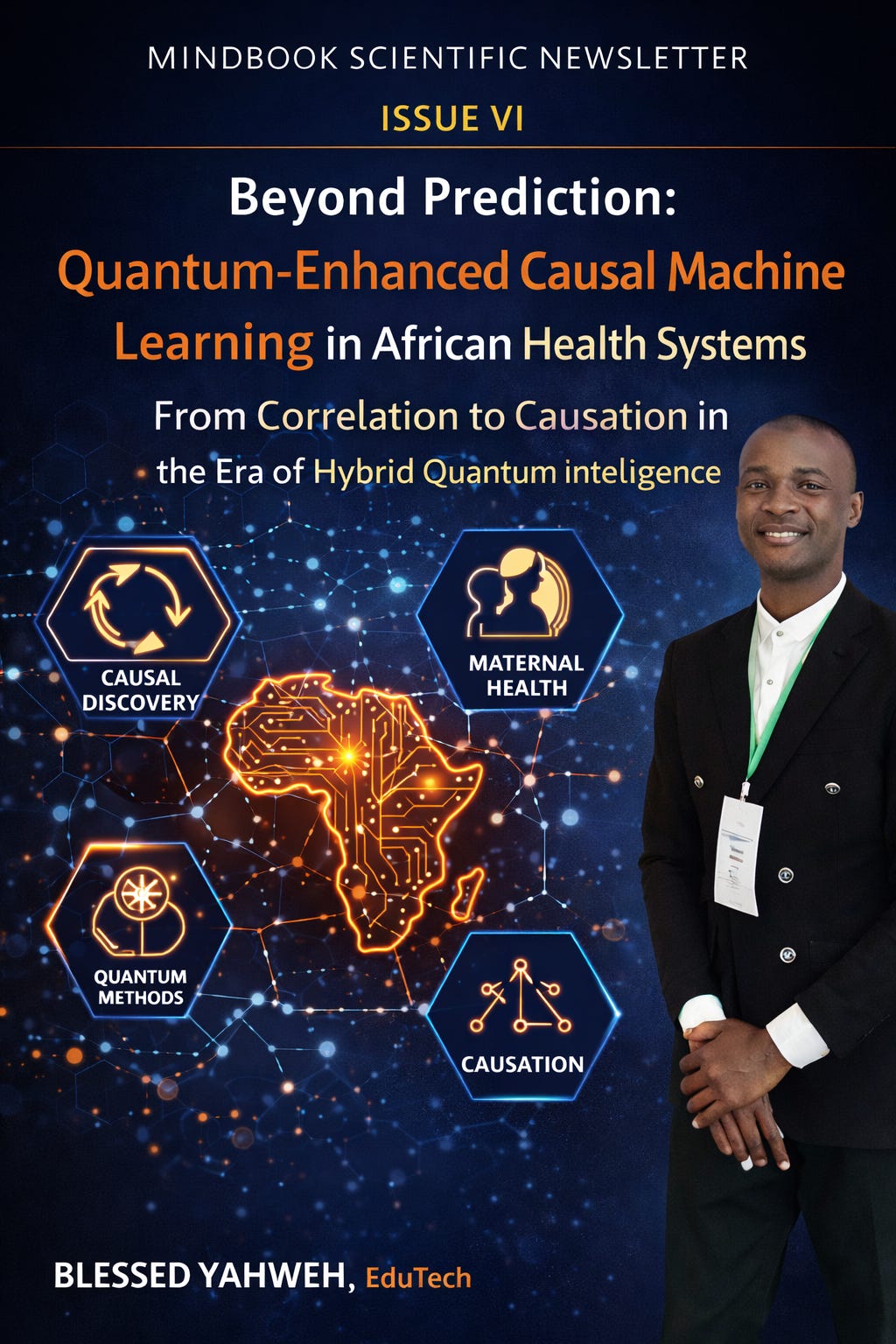
Beyond Prediction: Quantum-Enhanced Causal Machine Learning in African Health Systems
Uncovering the Missing Link Between Machine Learning and Real-World Health Outcomes

Executive Overview
Machine learning in healthcare has largely focused on prediction. Models estimate risk, classify images, and forecast outcomes. Yet prediction does not answer the central clinical and policy question: what intervention changes outcomes?
Causal inference addresses this gap. In African health systems, where randomized trials are costly and observational data dominate, causal machine learning is essential. Emerging quantum algorithms may influence how large-scale causal structure discovery and probabilistic modeling are performed [1], [2].
This issue examines that underexplored intersection.
1. The Limitation of Predictive ML in Public Health
Predictive ML models are optimized for correlation. However, policy and clinical decisions require counterfactual reasoning: what would happen under a different intervention scenario?
The distinction between correlation and causation has long been formalized in causal inference theory [3], [4]. In healthcare, failure to separate the two can lead to ineffective or even harmful interventions.
In low-resource settings, where datasets are smaller and confounding variables are harder to control, predictive instability becomes even more pronounced.
2. Why Causal ML Remains Underdeveloped
Causal structure learning from observational data involves identifying directed acyclic graphs that represent conditional dependencies among variables [3].
The computational burden increases super-exponentially with variable count. Even classical score-based or constraint-based methods become expensive in high-dimensional epidemiological datasets [5].
This is one reason why most healthcare ML deployments remain predictive rather than causal.
3. Where Quantum Computing May Contribute
Quantum algorithms are well-suited to certain optimization and sampling tasks. Quantum annealing and variational quantum algorithms have been explored for combinatorial optimization and probabilistic modeling [6], [7].
Learning causal graphs can be formulated as a combinatorial optimization problem. Quantum-enhanced optimization may reduce search complexity in large model spaces, particularly when combined with classical preprocessing in hybrid workflows.
Additionally, quantum sampling methods may assist in approximating complex posterior distributions used in Bayesian causal models [8].
These applications remain largely theoretical in healthcare contexts, representing a significant research gap.
4. African Use Cases Requiring Causal Insight
Oncology Treatment Pathways
Understanding which therapy sequences improve long-term survival requires causal reasoning rather than risk scoring.
Maternal and Child Health Programs
Multi-level interventions involving nutrition, infrastructure, and antenatal care demand identification of causal drivers rather than predictive associations.
Radiotherapy and Dosimetry Optimization
Treatment-response relationships require structured causal modeling to balance efficacy and toxicity.
In each case, causal inference supports policy evaluation where randomized trials may be infeasible.
5. Methodological Risks
Quantum acceleration does not correct bias, confounding, or missing data. Causal inference requires explicit structural assumptions and sensitivity testing [3], [9].
Moreover, current quantum devices operate in the noisy intermediate-scale era [1], meaning hybrid approaches remain necessary. Overstating computational advantage without rigorous benchmarking would undermine clinical credibility.
Methodological discipline must precede technological enthusiasm.
6. Strategic Implications
If African research institutions invest in causal ML literacy alongside quantum research exposure, they can:
Strengthen policy evaluation frameworks
Reduce dependence on externally designed trials
Develop context-aware epidemiological models
Contribute original research at the frontier of quantum-health integration
The advantage lies not in hardware ownership, but in methodological sophistication.
Closing Perspective
Prediction estimates risk. Causation guides action.
As quantum technologies evolve, their most meaningful contribution to healthcare may not be faster prediction, but deeper causal understanding.
The institutions that recognize this distinction early will shape the next phase of computational medicine.
Blessed Yahweh
EduTech
MindBook Scientific Newsletter
References
[1] J. Preskill, “Quantum computing in the NISQ era and beyond,” Quantum, vol. 2, p. 79, 2018.
[2] M. Schuld and F. Petruccione, Supervised Learning with Quantum Computers. Cham, Switzerland: Springer, 2018.
[3] J. Pearl, Causality: Models, Reasoning, and Inference, 2nd ed. Cambridge, U.K.: Cambridge Univ. Press, 2009.
[4] J. Pearl and D. Mackenzie, The Book of Why: The New Science of Cause and Effect. New York, NY, USA: Basic Books, 2018.
[5] P. Spirtes, C. Glymour, and R. Scheines, Causation, Prediction, and Search, 2nd ed. Cambridge, MA, USA: MIT Press, 2000.
[6] E. Farhi, J. Goldstone, and S. Gutmann, “A quantum approximate optimization algorithm,” arXiv:1411.4028, 2014.
[7] A. Lucas, “Ising formulations of many NP problems,” Front. Phys., vol. 2, 2014.
[8] S. Aaronson, “The limits of quantum computers,” Sci. Amer., vol. 298, no. 3, pp. 62–69, 2008.
[9] E. Bareinboim and J. Pearl, “Causal inference and the data-fusion problem,” Proc. Natl. Acad. Sci. USA, vol. 113, no. 27, pp. 7345–7352, 2016.